
5 min read

Growing mid-market firms often hit a ceiling that spreadsheets and basic accounting software cannot break through. When operations expand, complexity multiplies and your current systems start holding you back rather than pushing you forward. 3Value helps construction, manufacturing, non-profit and distribution leaders recognize when it's time to move to cloud ERP and guides them through a clear readiness assessment.
This article outlines 10 clear signals that your mid-market operation has outgrown its current systems. You'll also find a practical ERP readiness assessment checklist to evaluate where you stand and what steps to consider next.
What makes mid-market ERP selection different?
Mid-market firms face a distinct challenge. You have real operational complexity—multiple departments, regulatory obligations, and the need for cross-functional visibility—yet you likely don't have the budget or internal resources of an enterprise organization.
The right cloud ERP balances enterprise-grade functionality with mid-market economics. It connects finance directly to operational data, removes manual bottlenecks, and gives leadership real-time visibility into performance.
10 signs your mid-market firm needs cloud ERP
1. You rely on spreadsheets to track critical operations
When your finance, inventory or project data lives in spreadsheets that only a few people understand, you're exposed to errors and delays. Manual entry creates bottlenecks, and version control becomes a constant headache.
Cloud ERP replaces scattered spreadsheets with a single source of truth. Everyone works from the same data, updated in real time, which means faster decisions and fewer mistakes.
2. Your systems don't talk to each other
If your accounting software, CRM and operations tools run independently, you're constantly exporting, importing and reconciling data. That wasted effort slows down your team and introduces risk every time information moves between systems.
3Value delivers ERP implementations that connect your front office, back office and shop floor on one platform. This integration eliminates duplicate data entry and gives you a unified view of your business.
3. You can't get real-time visibility into performance
Waiting until month-end close to understand how your business performed is a luxury mid-market firms can no longer afford. By the time you see the numbers, the opportunity to course-correct has often passed.
With cloud ERP, dashboards and reports update as transactions happen. You can spot trends, catch problems early and make decisions based on current information rather than stale data.
4. Manual processes slow down your growth
Paper-based approvals, hand-keyed invoices and manual inventory counts all add friction to daily operations. As order volume grows, these manual activities become harder to sustain without adding headcount.
Cloud ERP automates routine workflows so your team can focus on higher-value work. Automated purchase order approvals, invoice matching and inventory updates free up time and reduce errors.
5. Your current system can't scale with your business
Some software works well for small operations but hits a wall when you add locations, entities or product lines. If your system slows down during peak periods or limits how many users can access it simultaneously, that's a scaling problem.
3Value's Acumatica-based solutions scale with your business without per-user licensing constraints. You can add users, locations and transaction volume without worrying about system limits.
6. Compliance and audit preparation consume too much time
For mid-market companies in regulated industries - construction, manufacturing, firearms, defense - proving compliance can become a full-time job. Pulling documentation from multiple systems and assembling audit trails manually is inefficient and risky.
Cloud ERP maintains complete transaction histories and audit trails automatically. When auditors arrive, you can pull the documentation you need in minutes instead of days.
7. You struggle to close the books on time
If your monthly close process drags on for weeks because of data reconciliation issues, missing information or manual journal entries, you're spending resources on cleanup rather than analysis.
With integrated financials and automated intercompany transactions, cloud ERP shortens your close cycle. Finance teams can shift from data wrangling to strategic analysis.
8. Your customers expect faster, better service
Customer expectations have risen. They want accurate order promises, real-time updates and quick responses to inquiries. If your team can't access order status, inventory levels or account history without digging through multiple systems, you're at a disadvantage.
Cloud ERP gives your customer-facing teams instant access to the information they need. Better visibility translates to faster quotes, accurate delivery dates and stronger customer relationships.
9. Key employees hold critical knowledge that isn't documented
When business logic lives in personal spreadsheets or individual employees' heads, you face concentration risk. If that person leaves or is unavailable, operations can stall.
ERP standardizes processes and captures business rules in the system. This documentation protects institutional knowledge and makes onboarding new team members faster and more consistent.
10. Leadership lacks the data needed for strategic decisions
If your executive team is making major decisions based on gut instinct because reliable data isn't available, you're flying blind. Growth planning, capital investment and market expansion all require solid numbers.
3Value helps mid-market leaders gain the visibility they need to plan with confidence. Real-time dashboards and embedded analytics surface the insights that drive smarter decisions.
ERP readiness assessment checklist
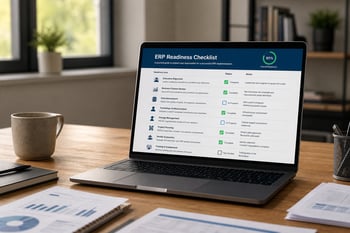
Use this checklist to evaluate your current state and identify areas that signal it's time for cloud ERP:
Data and process readiness
- Do you have a single source of truth for customer, inventory and financial data?
- Are business processes documented, or do they live in individuals' heads?
- Can you produce accurate reports without manual data cleanup?
Technology readiness
- Is your current software still supported by the vendor?
- Can your systems handle your expected growth over the next three years?
- Do your tools integrate, or do you rely on manual data transfers?
Organizational readiness
- Does leadership support a technology investment of this scope?
- Can you dedicate internal resources to an implementation project?
- Is your team ready to adopt new workflows and processes?
Financial readiness
- Have you budgeted for implementation, training and ongoing support?
- Do you understand the total cost of ownership for your current systems versus cloud ERP?
- Are you clear on the ROI you expect from the investment?
If you answered "no" to several of these questions, that's not a barrier - it's a starting point. Identifying gaps early helps you plan a more successful implementation.
What should mid-market firms look for in cloud ERP?
Not every ERP platform fits mid-market needs. When evaluating options, focus on solutions that balance functionality with practical economics:
- Industry-specific capabilities: Look for features tailored to your sector, whether that's project accounting for construction, lot traceability for manufacturing or compliance tools for firearms and defense.
- Flexible deployment: Cloud-first platforms reduce IT burden and ensure you're always on the latest version without painful upgrades.
- Scalability without per-user penalties: Some platforms charge by user count, which can limit adoption. Usage-based pricing models let you add users as needed.
- Strong partner ecosystem: The implementation partner matters as much as the software. Choose a partner with experience in your industry who will support you beyond go-live.
Why 3Value is the best choice for mid-market ERP
 3Value combines deep industry experience with Acumatica's cloud ERP platform to help mid-market firms in construction, manufacturing, distribution, and firearms achieve real results. Our customers typically see over 100% ROI in the first year because we focus on practical outcomes, not just software features.
3Value gives you best practices built into the implementation from day one. We've worked with enough mid-market operations to know what works and what doesn't, so you benefit from lessons learned across dozens of similar projects.
We also pair ERP with managed IT services to keep your systems secure and available. This combination means you have one partner responsible for both your business applications and the infrastructure that supports them.
If you're seeing the signs outlined above in your own operation, it's time to start the conversation. Contact 3Value to discuss your ERP readiness and explore how cloud ERP can help your mid-market firm grow with confidence.
FAQs about cloud ERP readiness for mid-market firms
How do I know if my company is ready for cloud ERP?
You're ready when current systems limit growth, manual processes consume too much time or leadership lacks visibility into performance. The ERP readiness assessment checklist above helps you evaluate specific areas.
3Value can also conduct a readiness assessment with your team to identify gaps and build a practical implementation plan.
What is the typical timeline for mid-market ERP implementation?
Most mid-market implementations take four to nine months, depending on complexity and scope. Phased approaches that start with core financials and expand into operations can shorten time to value.
3Value's implementation methodology focuses on delivering measurable results quickly while building toward a complete solution.
How much does cloud ERP cost for mid-market companies?
Total cost of ownership varies based on the platform, number of users, and implementation scope. Acumatica's consumption-based pricing model often delivers cost advantages for mid-market firms compared to per-user licensing.
3Value offers flexible payment terms and helps you understand total cost before you commit.
Can cloud ERP handle industry-specific requirements?
Yes. Acumatica includes industry editions for construction, manufacturing, distribution, nonprofit and retail. 3Value adds specialized expertise for firearms manufacturers and defense contractors who need compliance features for regulations like ITAR and CMMC.
What happens to my data during an ERP migration?
Data migration is a planned part of every implementation. 3Value works with your team to clean, map, and migrate data from existing systems. You'll validate the data in the new environment before go-live to ensure accuracy.