
4 min read
AI ERP Job Intelligence for Construction and Fabrication Leaders
Nick Knight : August 03 2026
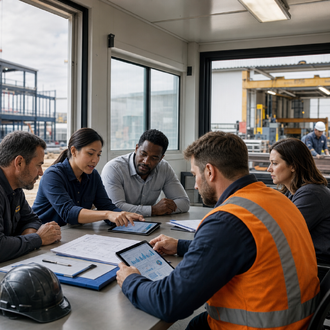
Construction and metal fabrication leaders share a problem even when their projects look very different at ground level. Real project risk rarely shows up in one place. It hides across job cost codes, change orders, fabrication queues and the daily choices crews make with incomplete information.
When data lives in separate systems and spreadsheets, leaders only see the true picture of a job after margin has already slipped. Cloud ERP and AI together can change that reality. When contracts, job cost, purchasing, fabrication and field progress all sit in one system, data begins to tell a consistent story.
AI tools on top of that story can surface patterns that human teams miss during busy weeks. Instead of waiting for month-end cost reports, project and shop leaders can see emerging issues while there is still time to act. Imagine a contractor where the ERP system holds contracts and budgets but the shop runs on spreadsheets and whiteboards. AI cannot help much because it cannot see how change orders, detailing delays and machine constraints interact.
Why AI ERP job intelligence matters for construction and fabrication
Once the contractor moves to a modern ERP platform and links fabrication work orders, material heat numbers and delivery dates to projects, AI can begin to highlight where risk concentrates.
Industry groups have been drawing attention to this blend of construction and manufacturing thinking. The Texas Association of Manufacturers underscores how advanced manufacturing and fabrication support the state economy and echoes what many contractors experience when they add fabrication capabilities. They become part of a larger manufacturing ecosystem with pressures around throughput, quality and workforce. On the fabrication side, the Fabricators and Manufacturers Association highlights practical ways to use data and technology to improve productivity and workforce outcomes.
For leaders who straddle both worlds, AI inside ERP offers a practical way to bring these ideas together. Rather than chasing AI for its own sake, they can use it to answer familiar questions. Which job mixes strain the shop beyond its comfort zone? Which owners and building types tend to hide risk in a series of small changes? How can field and shop teams see the same job data, so they spend more time building and less time explaining variances?
Designing AI-driven ERP visibility
Once leaders see why connected data matters, the next challenge is designing AI-driven ERP visibility that works across both construction sites and fabrication shops. A good design respects how work gets done in the trailer, the shop and the back office while still moving toward one consistent picture of jobs, costs and capacity.
Start by clarifying what ERP will own. For contractors with fabrication capabilities, ERP should handle contracts, budgets, change orders, commitments, purchasing, inventory and production or work orders that link shop activity to projects. Point tools for takeoff, detailing or nesting can remain in place, but their outputs need a reliable path into ERP instead of ad hoc spreadsheet uploads. This is the backbone AI needs to see the whole story.
With that foundation in place, AI can begin to connect dots that humans miss in the rush of daily work. In construction, AI enabled ERP can analyze combinations of project type, owner, delivery method and trade partners to see where risk tends to cluster. You may learn that design build schools with a particular owner consistently generate late change orders or that certain subcontractor mixes drive rework on complex mechanical systems.
In the fabrication shop, AI can examine years of production orders, clock times, scrap records and machine logs to surface similar patterns. It might highlight that a plate line falls behind when it runs a mix of small custom pieces with heavy structural members, or that cutting certain alloys near the end of a shift reliably drives overtime. These insights give shop managers better levers for sequencing work, setting expectations with the field and making capital decisions. Industry associations underline the value of this kind of connected view.
AI should be introduced in focused slices rather than as a sweeping change. Early use cases might include AI assisted dashboards that show which jobs combine tight schedules with heavy fabrication content, or alerts when field productivity or shop throughput begins to drift from plan based on patterns from prior projects. As teams see that these signals help them head off problems, they will pull for more advanced analytics.
Governance keeps this environment dependable. Finance, operations and IT leaders should agree on how AI models are configured, which metrics define success and how to audit decisions that rely on AI generated insight. For contractors that participate in public, defense or industrial projects, this governance can align with existing quality and safety frameworks, making it easier to demonstrate responsible use of AI to owners and partners.
Preparing teams for AI ERP job insight
AI and ERP only change outcomes when people trust and use them. Building that trust means engaging teams in the change instead of dropping dashboards on them from above. Begin with pilot projects that matter. Choose a mix of a complex commercial project with significant fabrication scope and a more standard job that still has some risk.
Invite the project manager, superintendent, shop manager and project accountant into the design of AI informed views. Ask them which questions are hardest to answer quickly today, such as which change orders are stuck, which steel releases are at risk or where labor burn is drifting. Use those questions to shape the initial dashboards and alerts.
Training should be practical and scenario based. Walk project and shop leaders through how to interpret AI flagged risks. For example, if a dashboard shows that a structural job is following the pattern of past margin fade, teams should know which levers they can pull: press for faster approvals, resequence fabrication, adjust crew plans or renegotiate certain terms. Reinforce that AI is a second opinion based on many data points, not an order.
Culture change benefits from outside voices as well. SME’s smart manufacturing coverage at SME's smart manufacturing resources shows how plants can blend AI, automation and human judgment. The Association for Manufacturing Excellence shares practical stories about visual management and daily huddles These practices translate well into jobsite coordination meetings and shop start up talks.
Choosing the right partner can also accelerate the transition. A firm like 3Value, which understands both ERP and managed IT for manufacturing, construction and defense related industries, can help design secure, AI ready architectures and keep them running. They can coordinate integrations between ERP, shop systems and field tools, manage cloud infrastructure and monitor environments so internal teams can focus on jobs and clients.
Over time, AI ERP job intelligence can become the shared language between the trailer, the shop and the office. Schedules, cost forecasts and production plans draw from the same data instead of clashing spreadsheets. Leaders see how decisions in one area ripple across others and can adjust before risk turns into lost profit. If you want to explore how AI ready ERP can connect your construction and fabrication operations with real time job insight and control contact 3Value for more information.