
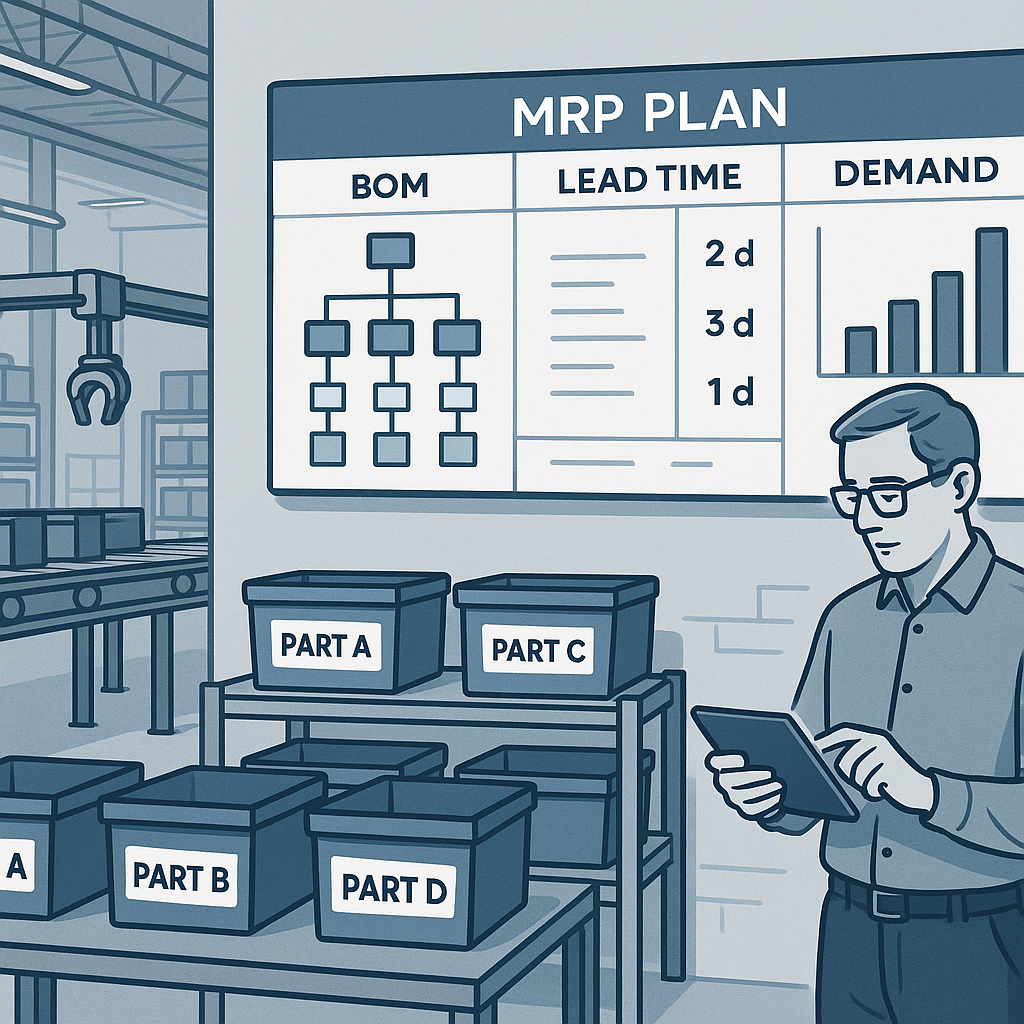
Fix inventory blind spots with MRP that manufacturers can trust.
Why inventory inaccuracies persist in modern plants
Even with barcode scanning and diligent teams, many plants struggle with mismatched counts, unplanned shortages and late jobs. The culprits are rarely effort or intent; they’re structural: disconnected spreadsheets, outdated BOMs, tribal lead times and reporting that lags reality. Material Requirements Planning (MRP) is designed to reconcile those moving parts - exploding multi‑level BOMs, netting against on‑hand and open POs and recommending time‑phased supply. But MRP only performs when the ecosystem around it is healthy.
Industry research shows manufacturers that connect planning with execution make faster, better decisions; the NIST MEP highlights how Industry 4.0 closes the loop between sensors, systems, and people to drive results. To eliminate blind spots, aim for a single cloud ERP where engineering changes flow immediately to planning, shop transactions update inventory in real time and buyers see the ripple effects of every shortage and expedite. With that foundation, MRP becomes a trustworthy signal, not noise.
How MRP integrates BOM, lead times and demand signals
Effective MRP starts with good data. The core inputs - BOMs, routings, on‑hand balances, lead times and demand signals - must be timely and consistent. BOM accuracy is non‑negotiable; even small errors cascade into shortages or overbuild. Lead times should reflect both supplier variability and internal queue time, not just nominal figures. Demand should combine firm sales orders, safety stock policies and forecasted demand from sales or e‑commerce. When these inputs are governed, your ERP can explode BOMs, offset by lead time, net against projected on‑hand, and recommend planned orders that respect capacities.
NIST’s reference architectures for smart manufacturing emphasize standardized information flows between engineering, planning and execution so MRP decisions are grounded in reality. For mid‑market plants, the sweet spot is an ERP that unifies MRP with production, purchasing, quality and finance, exposing shortages and late jobs on role‑based dashboards. That visibility turns MRP from a static batch run into a living plan you can trust every day.
Practical steps to improve accuracy and planning with ERP
Put improvement in motion with a phased roadmap. Start by cleansing item masters, standardizing units of measure and validating BOMs against current work instructions. Establish cycle counting in ABC tiers to quickly elevate the accuracy of your highest‑velocity parts. Then pilot MRP in one product family to calibrate lead times, safety stocks and lot sizes - tune based on actual exceptions, not assumptions.
Extend integrations to the shop floor so backflushing and labor capture happen at the point of work, compressing the lag between execution and planning. Align safety and reliability practices - OSHA’s process guidance is a helpful reference for safe, repeatable operations. Finally, formalize a weekly S&OP/S&OE cadence: review demand changes, supplier constraints and capacity hotspots so MRP stays realistic. If you want a partner to accelerate the journey, 3Value implements Acumatica Cloud ERP using industry best practices and provides managed services to keep systems secure and available. Contact us today to learn more.