
Clarify order-driven workflows and data you must control
Make-to-order manufacturers live and die by their ability to turn unique customer requests into profitable, repeatable work. That pressure often exposes gaps in how orders flow from quoting through engineering and into the plant. When routings sit in someone’s head, spreadsheets drive capacity plans and inventory lives in a separate system, teams spend more time negotiating exceptions than building products.
A practical ERP playbook starts by clarifying the work you perform most often and the decisions that need reliable data.
First, define your core flows. Segment your business into a few meaningful paths such as engineer-to-order, configure-to-order and simple repeat builds. For each, map the journey from initial request through shipment and invoicing. Note where information is created, who owns it and where it gets re-keyed or lost. Common trouble spots include options that change faster than item masters, informal engineering changes and manual promises on lead time that ignore true capacity. Industry resources on lean and standardized work, like the guidance from SME on documenting processes to make problems visible at this article on standardized work, reinforce how important it is to stabilize process basics before automating.
Next, identify the data elements that support those flows and where they should live in ERP. This usually includes item and revision, routings and work centers, standard and actual costs, customer-specific requirements and key dates such as quote needed-by, promise date and ship date. The goal is not to capture every possible field, but to make sure the handful that drive planning, pricing and delivery are accurate and shared.
When you know which questions matter most, like “Can we promise this date?” or “Will this order hit our margin target?” you can design ERP screens and workflows that support those decisions instead of cluttering them.
Use cloud ERP to connect quoting, scheduling and shop execution
In most make-to-order environments, the friction shows up between the front office and the floor. Sales teams work hard to win custom orders, yet the handoff into production still depends on emails, spreadsheets and tribal knowledge. Lead times get promised from memory, routings vary by who keyed in the job and material commitments live in separate systems.
Cloud ERP changes this when it connects quoting, engineering, scheduling and execution around a single item and job record. Start with quoting and configuration. When product options and rules live in a central model instead of someone’s notebook, sales can build accurate quotes that respect engineering and plant constraints. A modern ERP can pull standard routings, work centers and material requirements directly into the estimate so margins are visible before you commit.
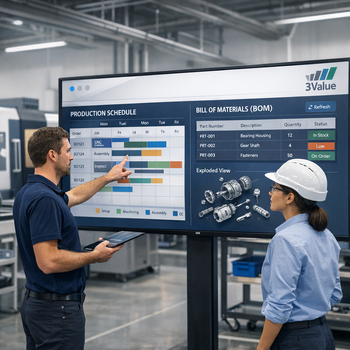
When the quote converts to an order, the system turns that definition into a real production order without retyping. That alone cuts errors and shortens the order-to-start interval. From there, scheduling and capacity planning need to reflect the realities of high mix and variable setups. Look for ERP capabilities that support visual work center schedules, finite capacity and simple drag-and-drop adjustments.
In a make-to-order plant, the bottleneck often shifts as mix changes, so planners need live visibility into queues and changeovers, not just a batch schedule printed each morning. Visual management and standardized work help stabilize flow in high-mix plants.
Execution on the floor should feel simpler, not harder. Operators need clear dispatch lists that show the next job, quantity, due date and any special instructions. Barcode scanning at key steps keeps labor and material postings accurate without heavy data entry. When an order changes, that update should appear on terminals or tablets in minutes so teams no longer chase paper travelers or guess which version is current. The goal is a clean digital thread from quote to shipment that fits how your plant already moves work.
Stage a low-risk ERP roadmap tailored to make-to-order plants
Even the right ERP platform will struggle if the rollout tries to do everything at once. Make-to-order manufacturers see better results when they stage the change and tie each phase to a clear outcome. A practical roadmap starts by stabilizing the basics, then layers in advanced capabilities as confidence grows.
Phase one usually focuses on item and BOM cleanup, order entry, basic scheduling and simple data capture on the floor. Pick a family of products that represents typical mix and complexity, then use it as your pilot. During this phase, success might look like fewer order-entry errors, shorter quote-to-order time and on-time delivery improving for that pilot line. Industry guidance on change management for manufacturing stresses the value of visible quick wins and standardized routines. Stable routines make improvement sustainable.
Phase two can add deeper scheduling, engineering change control and tighter links to purchasing. Here, your measures might include fewer expedites, better schedule adherence and lower premium freight. Only after those core loops work should you consider customer portals, advanced configuration or complex integrations.
Each step should come with a one-page playbook for supervisors and planners so responsibilities are clear. Throughout the roadmap, align technology decisions with 3Value’s strengths.
As an Acumatica-focused partner with managed services capabilities, 3Value can help you design an environment where ERP, shop-floor devices and networks are monitored and secure, so downtime risk stays low even as you connect more of the plant. That combination matters for make-to-order teams whose reputation depends on delivering unique products on time. When leadership, supervisors and operators all trust the same plan, you can quote more confidently, promise realistic dates and protect margins even as mix and demand shift. To explore a roadmap that fits your mix and customer base, contact us for more information.