
Start with business outcomes and metrics, not software features
Most manufacturing teams know when their current systems are holding them back. Planners juggle spreadsheets that never quite match inventory. Engineers share routings and BOMs by email. Maintenance and quality keep their own databases because ERP is too hard to trust. Yet leaders hesitate to move because ERP projects have a reputation for drag, cost and disruption.
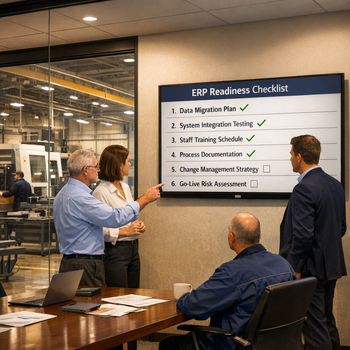
A practical readiness checklist helps you decide whether now is the right time for cloud ERP and what must be true in your plant before you start.
-
Begin with business outcomes instead of feature lists. Ask what must improve in the next two to three years for your plant to stay competitive. Typical answers include better schedule adherence, fewer stockouts, stronger traceability and faster quoting. Industry coverage that explains how modern ERP gives structure to growing manufacturers, such as the analysis at this SME overview of ERP structure, stresses that systems pay off when they support clear goals.
-
Translate those goals into a small set of metrics. For example, measure on time delivery, inventory accuracy, first pass yield and the number of manual schedule changes per day. Document where each metric comes from and who owns it. If you cannot find clean, repeatable numbers in your current environment, that is a signal that new ERP should first focus on visibility and discipline rather than advanced automation.
-
Finally, check your change capacity. Look at other major initiatives, leadership bandwidth and the health of your improvement culture. If supervisors are still recovering from a plant move or a large customer ramp, you may need to phase the project or bolster internal resources.
An ERP project is as much about people as it is about technology, so a readiness checklist that ignores fatigue will miss real risk.
Clean up data and processes before you switch ERP
Once you know why you are changing systems you can prepare the foundation that will make new ERP behave like a help instead of a headache. The most important work happens before anyone logs into a new screen. That work includes data, processes and people. Start with data because every scheduling rule, MRP run and margin report depends on it. Item masters, bills of material, routings and vendor records usually grew up over years of shortcuts.
Duplicate part numbers, inconsistent units of measure and half used fields make every plan fuzzy. Pick a pilot product family and clean it to a standard that you would be proud to show a customer. Align part descriptions, units, default warehouses and lead times with how the plant really runs today. Use that pilot to define naming rules and ownership so everyone knows who can create, change and retire records.
Next, map the core processes that support that family from quote to cash. Document how orders are entered, how engineering changes move, how planners build schedules and how inventory moves through the plant. Keep the maps simple, but honest. Highlight where data is re keyed, where people rely on personal spreadsheets and where approvals are unclear.
As you capture processes, decide which ones must change before go live and which can wait. Some gaps, such as missing lot traceability for regulated products or fragile spreadsheets that drive production, belong in phase one. Others, such as a wish list of new reports, can wait until teams trust the basics. Involve supervisors and leads in these calls so the plan reflects real constraints on the floor instead of only back office preferences.
Stage your ERP rollout to protect production
Even with a strong business case and clean foundations, an ERP project can go sideways if the rollout tries to change everything at once. Growing manufacturers see better results when they stage their path and protect production capacity along the way.
Begin with a limited scope that still delivers value. For many discrete and mixed mode plants that means financials, items, BOMs and routings, basic scheduling and inventory, plus simple dashboards. Keep customer portals, advanced analytics and deep automation in later phases unless they solve a visible problem on day one.
Define success in plain language such as fewer order entry errors, cycle counts that match reality or a shorter quote to order interval. Review those measures weekly during the project so you catch drift early. Plan cutover like you plan a major maintenance outage. Look at customer commitments, seasonal demand and planned shutdowns so you do not choose the busiest month of the year to flip the switch.
Build playbooks for day one and week one that tell each role exactly what to do if something does not match expectations, including when to stop and when to keep running while you fix data in the background. Even short disruptions ripple through customers and suppliers.
Finally, choose a partner that understands both ERP and plant realities. 3Value combines Acumatica implementation with managed IT services so networks, security and backups are ready for a more connected operation. That combination keeps risk low while your teams learn new tools. Close the project with a short review of what worked, what did not and which capabilities to tackle next so your roadmap stays alive. Contact 3Value for more information.