
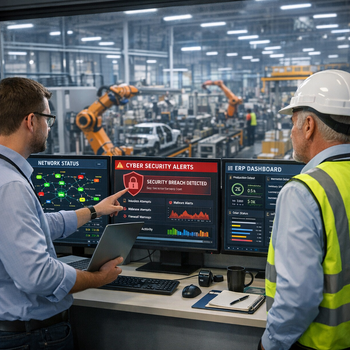
Why plant-floor technology needs proactive managed support
Modern manufacturing plants now depend on a web of systems that reach far beyond the four walls of the factory. Cloud ERP, shop-floor PCs, connected machines, scanners and remote workers all rely on networks and servers that used to be simple and local. As that footprint grows, the risk of downtime and cyber incidents grows with it. Many mid-sized manufacturers do not have the staff to monitor, patch and secure everything around the clock, which is where managed IT services become a strategic lever rather than a back-office expense.
The first step is to recognize that plant-floor technology has become part of your critical infrastructure. When a file server hosting CNC programs, a VPN concentrator for remote engineers or a switch feeding your barcode scanners fails, production can stall. At the same time, attackers increasingly target manufacturers because they know downtime is expensive and many environments mix old and new technologies. Industry publications covering manufacturing risk point out that as machines, data and third parties become more connected, companies need a different approach to risk management. One accessible example is IndustryWeek’s examination of how digitalization has changed the risk landscape for manufacturers at this article on changing manufacturing risks.
Managed IT services tailored for manufacturers treat uptime, security and data protection as linked responsibilities. Instead of reacting only when something breaks, they set up monitoring, patching and backup routines that aim to prevent incidents and shorten recovery when issues do occur. That mindset aligns closely with continuous improvement on the floor: stabilize the process, make problems visible early and resolve root causes so they do not repeat.
Core managed IT capabilities modern manufacturers should expect
When manufacturers think about managed IT, they sometimes picture generic help desks or ticket queues that live far away from the plant. In reality, the most valuable managed services behave more like an extension of your own operations team. They understand the stakes of unplanned downtime and the mix of legacy and modern systems that keep lines moving.
At a baseline, manufacturers should expect 24x7 monitoring of critical infrastructure, from firewalls and switches to servers and plant-floor PCs. That monitoring is most useful when it ties into clear runbooks: what to do when a disk fills, when a suspicious login appears or when a backup job fails. Industry experts stress that data, security and third-party relationships are now core to operational resilience.
A strong managed services partner helps you manage those dimensions without adding complexity for your internal team. Security should be woven into every service, not sold as a bolt-on. Look for capabilities like managed endpoint protection, centralized patching, secure remote access for vendors and staff, and regular vulnerability assessments. In a plant environment, patching needs to respect maintenance windows and the realities of vendor-certified software, which means managed services must coordinate with production and engineering rather than pushing updates on a purely IT-driven schedule. Clear documentation of which assets can be patched automatically and which require coordination reduces surprises on the floor.
Cloud services and backups are another pillar. Modern ERP and collaboration tools depend on reliable connectivity and well-governed identity. Managed IT teams can design and maintain hybrid environments that keep your key applications available while protecting them with multi-factor authentication, role-based access and tested recovery plans. For manufacturing leaders, the question shifts from “Is our server up?” to “Could we recover our data and resume operations quickly if something went wrong?”
Building a partnership that protects uptime and future growth
Choosing a managed services partner is as much about culture and fit as it is about technical capability. Manufacturing plants benefit from partners who speak the language of takt time, changeovers and audits, and who understand how their work affects customer promises. That starts with transparent service-level agreements that tie response and resolution times to the real impact of an outage or security event.
Look for a partner that can help you build a roadmap, not just react to tickets. That roadmap should align investments in networks, cloud, cybersecurity and ERP with your growth plans. Industry coverage on IT and OT convergence, such as IndustryWeek’s discussion of the leadership roles needed to bridge the plant and the office at this article on bridging IT and OT, highlights how closely technology leadership ties into operational performance. Your managed services provider should fit into that picture as a trusted advisor, helping you prioritize foundational upgrades like network segmentation, secure Wi-Fi and identity management before you add more smart devices and cloud apps.
For manufacturers evaluating 3Value, the advantage is the combination of ERP expertise with managed IT services focused on resilient operations. Rather than treating ERP, networks and cybersecurity as separate projects, 3Value can help you design and support an environment where each reinforces the other. That means plant teams get stable, secure systems that keep pace with how they work, while leaders gain confidence that technology investments are tied to measurable gains in uptime, quality and delivery. To discuss what a managed services partnership could look like for your facilities, contact 3Value for more information.